I’m trying to figure out if your Fryette Power Station PS2A is right for my needs.
(Or maybe the Power Station 100 might be even more useful).
My rig:
Electric Guitar.
RJM Music Mastermind PBC 10-Loop Switcher pedal effects (with compressor, overdrive, distortions, modulations which I usually use in parallel mode).
Fender twin reverb amp (without loop effect).
Focusrite Claret 2 Pre (for home recording).
My goals:
Reduce the volume when I play at home while keeping the amp at a level that sounds good.
Have an output to plug into my sound card for recording.
Have an effects loop to enhance my effects chain (overdrive, distortion before the amp, and modulations in the effects loop).
My questions and concerns:
Generally, in amplifiers, the effects loop is placed between the preamp and the power amp. In my case (Fender twin reverb), with the Fryette Power Station, I’d have the effects loop after Fender pre and power amp. Would that be correct?
Perhaps the biggest doubt I have: my amplifier is designed not to distort even at high volumes. Would this be a limitation for me, since I wouldn’t have the advantage of being able to get distortion from the amplifier (keeping its volume high) and then use the Fryette Power Station to reduce the volume but maintain the distortion? I think the Fryette Power Station’s usefulness is greater with an amplifier that distorts. Could the Fryette Power Station be a less usable combination with the Fender Twin Reverb?
I hope I was clear enough and thank you in advance.
Yes, that’s correct which is fine and more or less the same thing. With a delay pedal in front of your amp, you are stacking input signal into the front end of the signal chain which CAN get a bit messy. Sometimes that’s what you want. Sometimes that’s not what you want. A lot of people want a delay to be a simple reflection of their guitar tone / playing. That’s where the effects loop comes in. It’s more like adding a delay plugin to an already recorded track in a DAW (assuming an effects loop on an amp is before a mostly clean power section). So, the Power Station actually adds to this concept. You can take older master volume amps that don’t have an effects loop and you have to crank them to get your tone, run that amp into the Power Station to get your tone at reasonable volumes, add your delay or whatever in the Power Station effects loop, and you’re off and running.
Yeah, that kind of depends on how you feel about your tone at different volume levels on the Twin Reverb. Tube amps are often producing distortion even if it’s not distortion that you hear as out right distortion. A lot of times, it’s a subtle “warming” of the tone going from lower volumes to somewhat higher volumes because you are getting the tubes in the preamp and power section working just a little harder. Sometimes that’s what you want. Sometimes that’s not what you want. All the Power Station is doing is giving you more options and flexibility to explore that.
Yup. Power Station works great for this. Something to keep in mind (which you may or may not already know). You will need to run a hardware IR loader / cab sim after the Power Station and before your audio interface. Or skip the hardware and just run the Power Station into your audio interface and load up a software IR loader (either standalone or in your DAW). Otherwise, you are hearing the raw signal of your amp off of the amp’s output which is probably not what you’re expecting.
If you already have it, then yes that will work. If you are planning to buy it or something else, I would probably recommend getting a dedicated IR loader software. I use several different ones.
Are you planning to use this with a DAW? Or do you want a standalone option?
You have many more options if this will run as a plugin with a DAW (including a lot of free ones). Fewer IR loaders have a standalone version.
I use GGD Studio Cabs most of the time and a big part of that is that it is both a plugin and standalone. So, there’s one application that I need to know and use. Not saying it is the best thing ever but it makes sense for me.
York Audio has some really great IRs. They have their FTWN 212 D120 IR pack which is the first thing that comes to my mind for you.
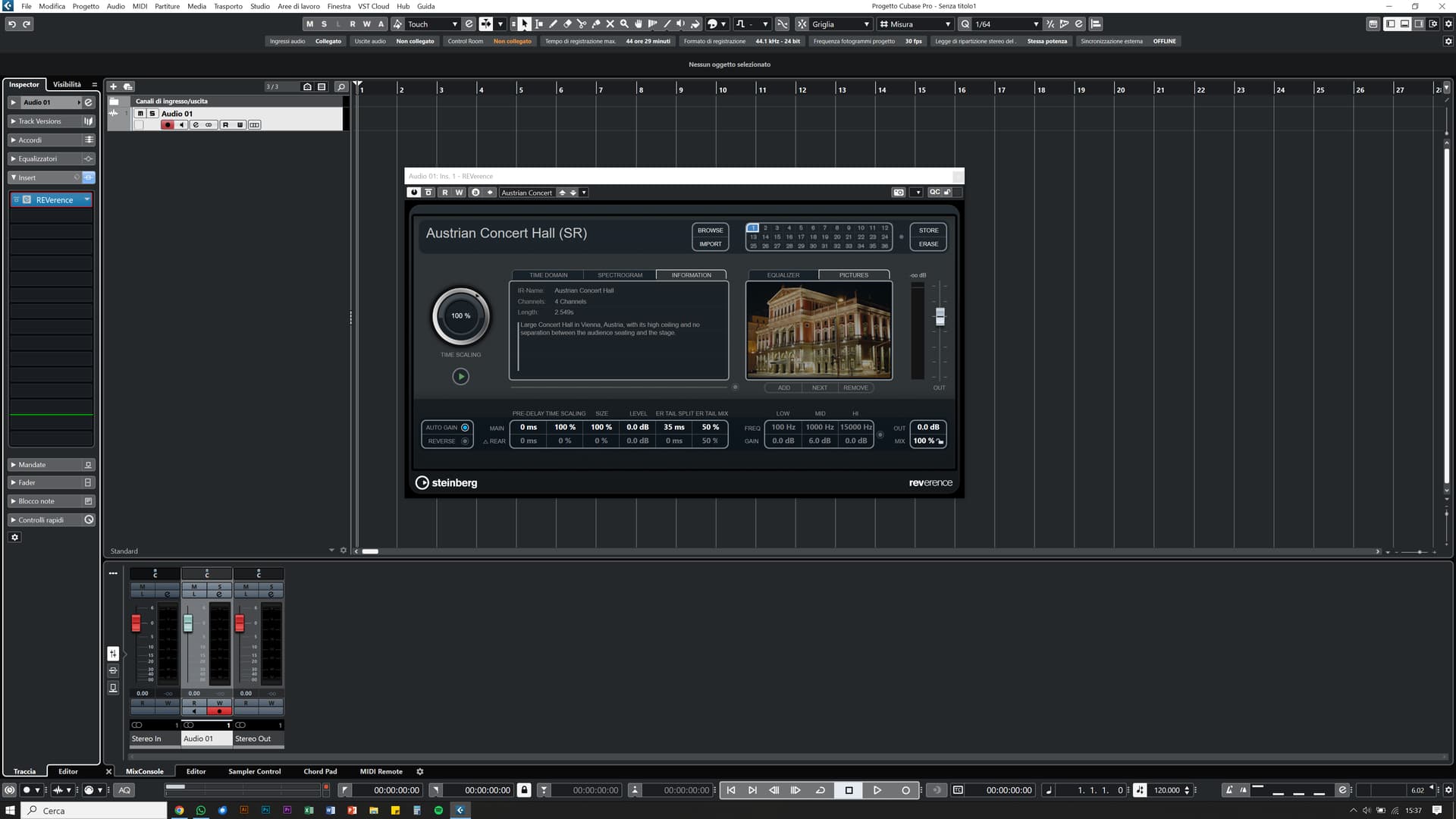
Which version? I don’t use Cubase very much but I am aware that the Pro version includes REVerence which is a convolution reverb and those can load IRs. You just generally need to set your reverb mix to 100% so that your entire signal is running through the IR. This would be a fine free way to start out with IRs so that you aren’t spending any more money than you have to.
I primarily use Logic and it includes Space Designer which is also a convolution reverb and the same concept applies there.
Yes, I apologize, as my prior response wasn’t clear. You would want to purchase and download the York IRs (or whatever IRs you may want to use). Then, you load the IR file into REVerence. Set mix to 100%. Will sound super realistic in terms of getting a mic’d cab sound from your amp. After that, you can add additional effect plugins (reverb, delay, whatever) in the DAW to get your final sound if needed.
I haven’t looked but I am sure there are probably some good YouTube videos on this topic. If I were you, I would go to YouTube and search for “using guitar cab IRs with REVerence in Cubase” or something like that. I’m sure someone has done a tutorial on it.
The Power Station suffers from a big design flaw: the “line out” is placed before the FX loop and cannot be changed. This is something that the Boss Tube Amp Expander gets right… sort of. For true flexability, a line out should be switchable pre- and post-loop, as seen on many amps. You will find a number of convoluted workarounds that are unlikely to work well, but are worth a shot.