PS-100 vs PS-2A — Line Out signal characteristics & 50W vs 100W performance for IR-in-DAW workflow with a 100W head

Hi all (and Dan, if you have a moment),

I’m a long-time tube amp player in Finland looking to add a Fryette Power Station to my rig, and I’d really appreciate some explicit clarification on a couple of points before I commit to either the PS-100 or PS-2A. Hoping the community and Fryette staff can help me make the right call.

My setup:

  • Mesa/Boogie JP-2C (100W, 4× 6L6)
  • Mesa Rectifier Traditional 4×12 Slant cab (8 ohm)
  • Focusrite Scarlett 2i4 (1st gen) audio interface
  • Apple Logic Pro DAW
  • High-gain metal player, mostly home and moderate (apartment / small rehearsal) volumes

My recording goal: I want to capture a raw amplifier signal directly to my interface and apply cab IRs in Logic Pro. No micing the cab, no relying on built-in cab simulation, no double-stacking IRs with analog cab sim.

I’ve read both manuals carefully and read through several forum threads here (especially Dan’s reply on the PS-2A LINE OUT being “raw guitar amplifier signal at a line level,” which was super helpful). But I still have some specific questions I’d like cleared up before purchasing.


Question 1 — Line Out signal characteristics on both models

I’d love an explicit, point-by-point breakdown of what signal each of the following four outputs actually carries. Specifically, whether each is frequency-compensated (and how aggressively), or a raw/flat tap of the speaker signal:

  1. PS-100 LINE OUT (1/4" unbalanced) — the manual calls it “frequency compensated.” What does this mean in practice? A fixed analog cab simulation? A simple high-cut filter? Something else? Can I still apply a DAW IR plugin downstream without it sounding like double cab sim?

  2. PS-100 LINE OUT XLR (balanced) — the manual describes this as “transformer isolated, balanced line output of signal coming from amplifier connected to Amp In” without repeating the “frequency compensated” wording. Is the XLR signal the same frequency-compensated signal as the 1/4" LINE OUT (just balanced + isolated), or is it actually a separate, flat/raw tap?

  3. PS-2A LINE OUT (1/4" unbalanced) — Dan has said this output provides “raw guitar amplifier signal at a line level.” Can someone confirm: is this output completely flat with no frequency compensation, no low-pass filtering, no cab-sim circuitry of any kind? Just a clean line-level tap of the speaker signal?

  4. PS-2A LINE OUT XLR (balanced) — same question as #2 but for the PS-2A: same signal as the 1/4" LINE OUT, or processed differently?

Bottom line: I want to know definitively which output on which model gives me the cleanest possible raw amp signal to feed an IR loader plugin in Logic Pro.


Question 2 — 50W vs 100W internal power amp performance with a 100W head

I understand both PS models share the same reactive load capacity (200W max @ 2/4/16Ω, 150W @ 8Ω), so both should accept my JP-2C safely from a load perspective. What I’m trying to understand is the practical performance difference between the PS-2A’s 50W internal tube power amp and the PS-100’s 100W internal tube power amp when re-driving a real cabinet at moderate-to-low SPL (apartment volume) with a 100W source amp:

  • At low SPL / heavy attenuation, is there meaningful loss of dynamic range, headroom, or amp “authority” / feel using the PS-2A vs the PS-100?
  • Does the PS-2A’s 50W power section run closer to its limits at usable home-volume settings, while the PS-100 retains more headroom?
  • Tonal character — 6L6 (PS-2A) vs 6550 (PS-100) — does it matter much when paired with my 6L6 JP-2C?
  • For someone in my situation (one 100W high-gain head, home/moderate-volume use, tone-first priority), which model would you recommend on performance grounds? Or are they essentially equivalent for this use case?

Cost isn’t the deciding factor — I’m looking for the right tool for the rig.


If anyone here owns either unit (especially if you’ve A/B’d them with a 100W high-gain amp at home volumes), your firsthand experience would be hugely appreciated. And if Fryette staff can chime in on the LINE OUT signal-flow question definitively, that would help a lot of future buyers in the same situation as me.

Thanks in advance for any insight!

Cheers,
Okko
Quick follow-up to my own questions above:

I just noticed that the PS-100 manual was revised between Dec 2019 and Jan 2021 — and the LINE OUT description was changed. The original 2019 manual called it “a frequency compensated output,” but in the 2021 revision that wording is removed entirely, and the description is now word-for-word identical to the PS-2A manual’s LINE OUT description.

So my question becomes more specific: was this just a manual wording correction (i.e., the PS-100 LINE OUT was always raw, and the original manual was inaccurate), or did the hardware actually change at some point?

I want to ask some general followups:

At low SPL / heavy attenuation, is there meaningful loss of dynamic range, headroom, or amp “authority” / feel using the PS-2A vs the PS-100?
Does the PS-2A’s 50W power section run closer to its limits at usable home-volume settings, while the PS-100 retains more headroom?
Tonal character — 6L6 (PS-2A) vs 6550 (PS-100) — does it matter much when paired with my 6L6 JP-2C?
For someone in my situation (one 100W high-gain head, home/moderate-volume use, tone-first priority), which model would you recommend on performance grounds? Or are they essentially equivalent for this use case?

“low-SPL” and “home-volume” are extremely subjective. not to mention that “volume” is a quantity of perception which is frequency dependent, and that a bass heavy signal will use more power for the same apparent volume.

when I run my 50 W amplifiers at home, it’s obvious that the power amplifier/transformer/supply are working in a non-linear regime. but if you’re talking about “whisper quiet don’t bother the baby in the other room or your partner watching television,” well then maybe the dynamic range or 50 W vs 100 W is less important.

I’m guessing you maybe have seen this video, but if not, I think it’s relevant: Is the PS-2 or the PS-100 better for bedroom playing?

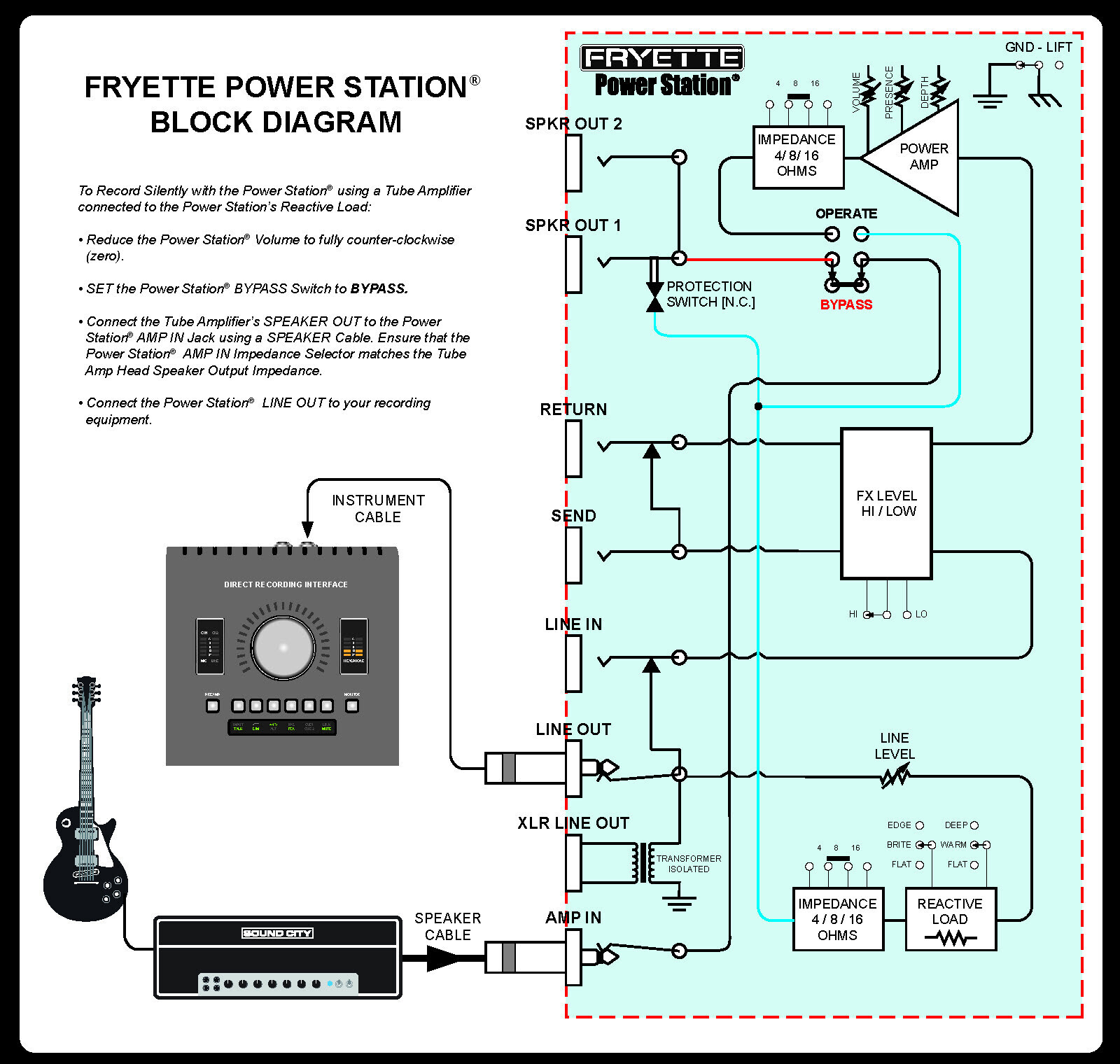
I also want to add that the line out mechanisms are “before” the power amplifier section of the power station, so if your main figure of merit is the recorded (direct) sound, the power amplifier in the power station won’t have a big effect on that.

this is the block diagram I’ve seen posted for questions about the ps-2a. hopefully support can comment on whether it’s also applicable for the ps-100

@opy great questions and welcome to the forum, and don’t let me get in your way of chatting with @choalla , but I’ll drop some specifics answers to the technical questions below.

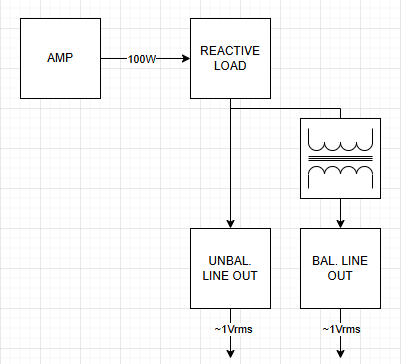
This is the Power Station Line Out circuit for both the PS-100 and PS-2A

Your amp hits the reactive load at around 100W, then we tap off a little bit of signal from the reactive load and go straight out on the unbalanced line-out.

The same signal goes into the an isolation transformer and then out the unbalanced (XLR) line out.

Ideally there should be no difference between these signals; they are the true signal your amps are driving into the reactive load, including all the reactive interactions. This signal can be tuned using the front panel toggle swtiches, as they change the reactive profile.

Ignore this, there is no frequency compensation in Power Station.

See above.

Yes, see above, unless you want a second opinion :slight_smile:

See above; it’s the same circuit.

Q2

The thing that is special about the Power Station is that your amp sees a reactive load that looks, to it, like a speaker, so this reserves the reactive interactions between the amp and the “speaker” (the reactive load). And your speaker sees a real tube amp, so this reserves the interactions between your speaker and the tube amp.

In terms of differences between 50W and 100W, unless you need the boost to 100W and you need the two volume controls, I’d just buy the lower-cost unit. You mentioned this will be used for lower volume at worst, but typically for a silent recording.

At low volumes I would expect them to perform identically. At higher volume the PS-2A will sag and start to add it’s own tube character to the sound earlier than the PS-100.

No, it does not matter. There is a long answer to why.

I think either will fit, or, put another way, I don’t think you will miss anything by selecting the PS-2A over the PS-100. In your case because you will not be pushing the Power Station to high volume levels. But if you prefer the PS-100 “just in case”, it’s not a bad choice.