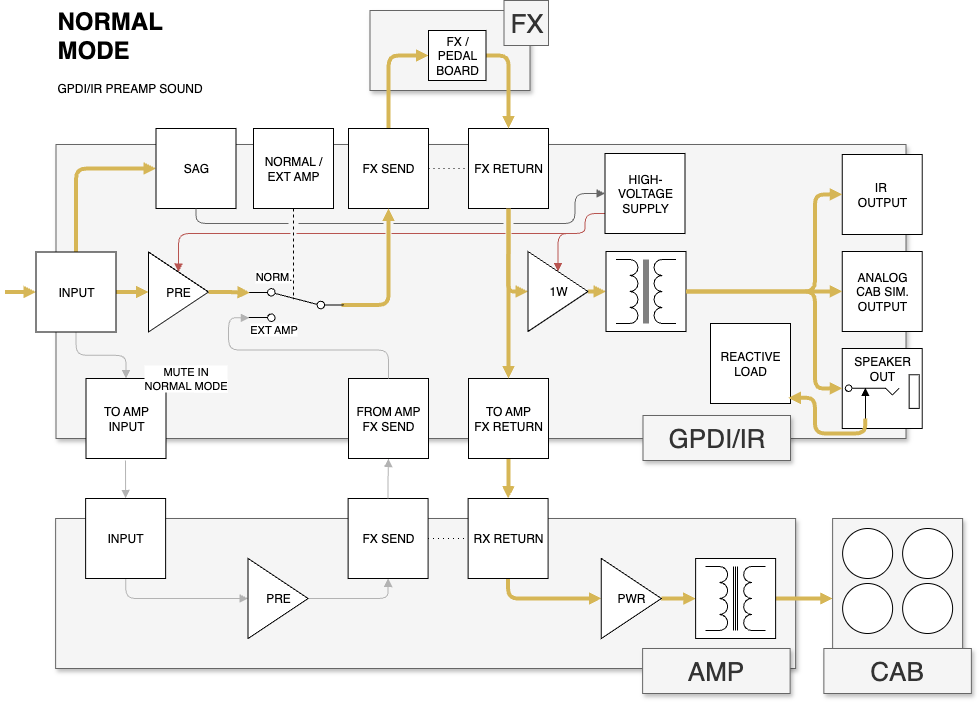
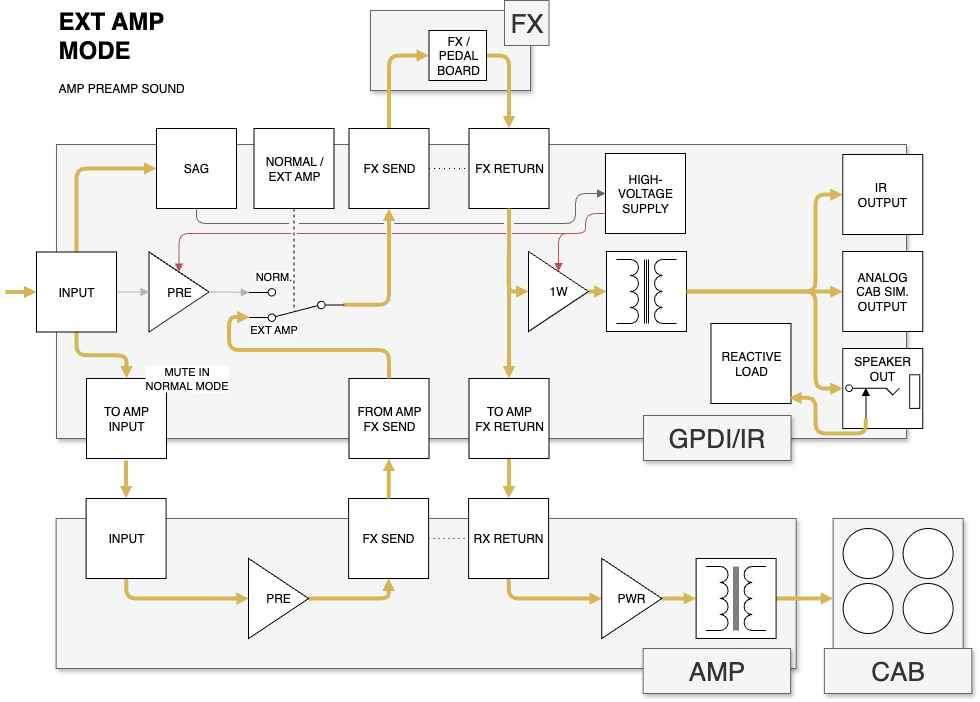
Hopefully this will help rig builders understand a bit more about how to integrate their GPDI/IR with external amplifiers. Any requests, let me know.
Normal Mode
In normal mode you hear the GPDI preamp going into your amp’s power amp and then to your amp’s speaker. Note that all the usual outputs from the GPDI/IR are still available to you if you wish to use them. This is similar to “Add a channel” in Synergy’s products.
In external amp mode the GPDI/IR routes your guitar into your (external) amplifier and extends its FX loop (your FX are connected to the GPDI/IR but it’s as if they are connected to your amplifier).
Add reactive load on normalised output jack. With the speaker connected, the tubes see you, speaker; when disconnected, they see the internal reactive load.
I deleted my prior questions because I was asking too much in too many words, but with not enough detail as to what I was trying to figure out with all of the routing and signal options. I figured I would try and plan out my questions in smaller segments. I figured that first I should lay out the list of gear I have at my disposal in attempts to build a studio / recording / practice / experimentation rig.
GP/DI-IR
PS-100
PL-IR
Cyclops
Vox AC30C2X Combo amp
BOSS GX-700 rack mount FX + amp sim (very old piece of gear with FX LOOP that can switch between series and parallel)
LEHLE P-ISO Isolation transformer (x2)
ASHLY MX508 Stereo Line / Mic Mixer
Various DI boxes with THRU jacks
Various pedals of all kinds including germanium fuzz units that need to come very first in the signal chain
My first question is in regard to the balanced XLR Direct Out on the GP/DI-IR. Could this be used in conjunction with a type of re-amp box, or an impedance matching transformer cable like the Audix TK50, to send the dry guitar signal to the input of the Cyclops, the GX-700 processor, and/or AC30? My primary goal is to essentially use the GP/DI-IR in external amp mode with my AC30, then possibly find a way to simultaneously drive the power amp section of the GP/DI-IR with the preamp sims on the GX-700, and then blend the sounds into the power amp of the AC30, then to the PS-100 for attenuation. Is the standard FX LOOP on the GP/DI-IR interrupted if nothing is connected to the SEND jack, and only the return, while connected to another amp in external mode? Again, even trying to simplify my questions I still can’t seem to make them concise, and I might just need to simplify my entire approach altogether.
We should hire you to give a seminar on how to ask a question.
It’s an instrument-level output (it’s tube buffered and split into a balanced signal) so if you want to connect that to line-level it will be quite low. You could try the isolation transformer if you want, but typically they are designed for line-level and have low output impedance. This is designed to connect to a guitar amp input. The result of this is frequency roll-off. But it’s worth a go.
@Terry – can this be done using a splitter? I think this might be possible by abusing the FX loops. But Terry is the expert here. For example, connect your FX return to a splitter, then return one output to your amp, and the other goes into whatever gear will return to the GPDI/IR’s FX loop. A word of warning. This will be very prone to ground loops.
They are normalled, with the FX send connecting to the wiper of the FX return. This is the same in all modes.
If I’m reading what you want to do correctly, it sounds as if you want to use multiple preamp sources, GPDI-IR, the AC30 preamp, and sounds from your GX-700 through the power section of the GPDI-IR. If that’s correct, that’s a bit more than a splitter. This also sounds like you’re trying to sum/blend two or more sounds together back into the effects return of the AC30 while keeping the functionality of the switching in the Cyclops.
I’ll tell you what I’ve told many clients; anything is possible, but it’s going to take time, money, and require a lot more gear. You could use something like a Voodoo Labs GCX and run it to make the sends and returns into a kind of A/B/C selector of where you want the signal going and then in return what signals you want coming back into the system. This would also require some way of summing the signals to get a “blend” of the sounds. Something like a unity gain line mixer.
I’m not going to tell you to give up on your dream of building this system. I am going to say that it is going to require looking at your needs, planning out the system, and then building it. This isn’t a simple setup whatsoever. It has a lot of moving parts (the switching on this alone is not simple).
If I missed something, please let me know. Or, if I misunderstood something, please correct me.
That definitely answered my questions, and took care of a few more that I hadn’t even asked yet. Much appreciated!
Seeing as I can’t afford the extra gear required to make that rig happen at the moment, and mostly just want to commit to a decision with the gear I have now, I can jump ahead to my final few questions.
Using the GP/DI-IR connected to my AC30 Loop for external amp mode, will the Cyclops still function properly if I connect the “amp in” output to the input of the GP/DI-IR rather than the AC30 input? Or will that create another ground loop due to the AC30 amp output being connected to the PS-100 and not the GP/DI-IR?
I would like to be able to record the effects happening in the GP/DI-IR FX LOOP, especially since it extends the loop on my AC30, but I know that the PS-100 FX LOOP only operates at the speaker output. I wanted to use the PL-IR to address that, but connecting the PL-IR to the speaker out of the PS-100 seems to be providing too weak a signal to my mixer, which I assume is due to the fact that the PL-IR is seeing the attenuated signal, and not the full amp output of the AC30. My AC30 has been modified for use with the PS-100, due to the fact that it has two load amp outputs but no speaker input jack, with the speakers hard wired. The external amp jack, when connected, disconnects the amp from the internal speakers, and the modification is a simple input where I can send the PS-100 out back into the internal speakers of the AC30. The extension amp output is where I wanted to try and add the PL-IR, running in parallel with the external amp out, AC30 set to 8ohms hitting the PS-100, so I could be recording the full sound of the power amp signal and not the PS-100. Would that be a recommended idea, or should I simply connect the speaker out of the GP/DI-IR to the PL-IR if I wanted to record the effects happening in the GP/DI-IR loop and forego the power amp of the AC30?
Let’s try a more direct approach, why do you need to run this way? What are you really trying to accomplish. Is it just for switching between a couple of preamp sections? Using the outputs in different ways?
The issue I’m having is how to proceed because I really still don’t know the why. You’ve got some pretty extensive questions for us to answer but have maintained complete ambiguity at the same time.
If this is for live use, it’ll have a totally different set of needs than if it’s for studio use. If it’s for studio use and the reasoning for all of the switching being needed is where the gear has to be set up and how difficult it is to just change the cables by hand, that also is a totally different set up.
This setup is for home studio use and home recording in an apartment, general practice, tone sculpting and experimentation with various effects. The “why” is due to the small space I have to set everything up in, and not wanting to always be plugging and unplugging cables to route signals. I need the PS-100 working as an attenuator because the volume has to stay reasonable in an apartment.
Quick question - when in Ext Amp mode, the master volume is disabled - does that mean that the side-chained Sag is also disabled (ie does not affect the 1W amp)?
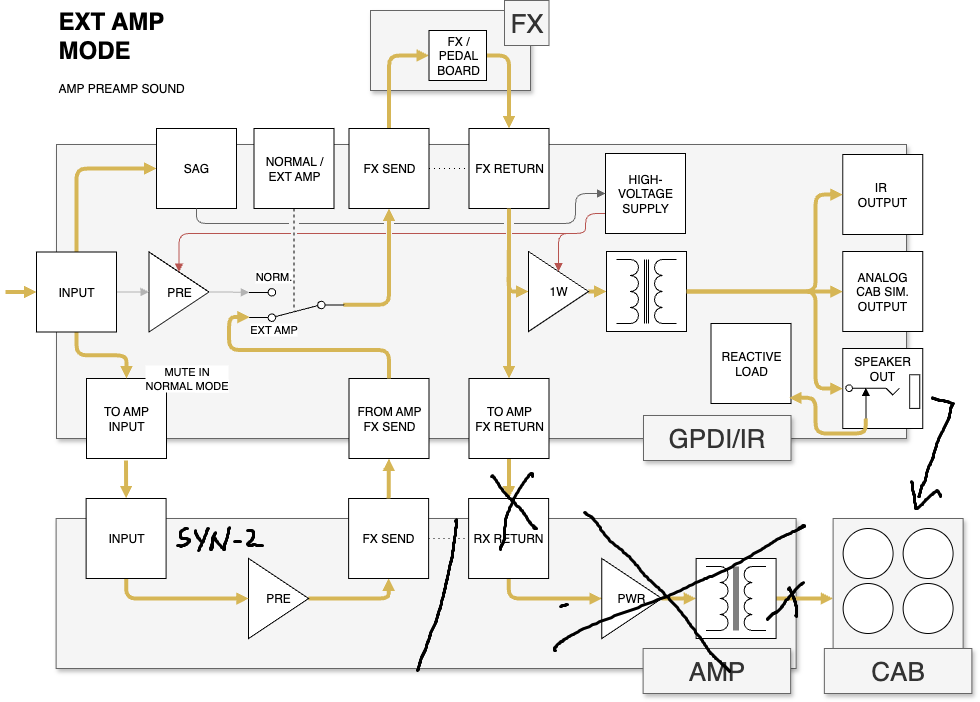
For perspective I am intending to use the GPDI Ext Amp configuration with SYN-1/2 modules inserted in the “To Amp Input/From Amp FX Send” Loop (and using the GPDI power amp output). I can of course do the reverse (insert the GPDI into Syn modules loop) but debating which would be the best option (and figure out if/how the respective Sag functions will apply).
Sag is derived from the input signal at an early place in the preamp (first stage actually). Provided you put the guitar signal into the INPUT the sag control will work.
Thanks, that was my understanding but I was afraid that the sag could have been disabled (just as the master volume is disabled) when in Ext Amp mode. Based on your answer, it then seems more appropriate to use the GPDI Ext Amp mode (rather than the SYN’s) with the GPDI power amp Sag being applied to all preamps (so the SYN sag may eventually be left “off”)?
^^ Thanks for this! I came here with a really similar question… wanted to know how to integrate a SYN-1 and module with the GPDI-IR so that the power stage and sag of the GPDI-IR were utilized. Even though your diagram is for the SYN2, this worked perfectly for me with the same-labeled connections of the SYN-1.
I am still noticing that the “volume” knob in the Master section of the GPDI / IR is not operative when the GPDI / IR is in “ext amp” mode. I’m assuming that is as-expected, and this does not indicate the built-in power amp is out of the signal?
Yes. Even though the master volume is disabled in Ext Amp mode (takes a bit of gain staging to get everything balanced) the sag funciton (as indicated by the red arrows) still applies to the power amp when in ext amp mode.